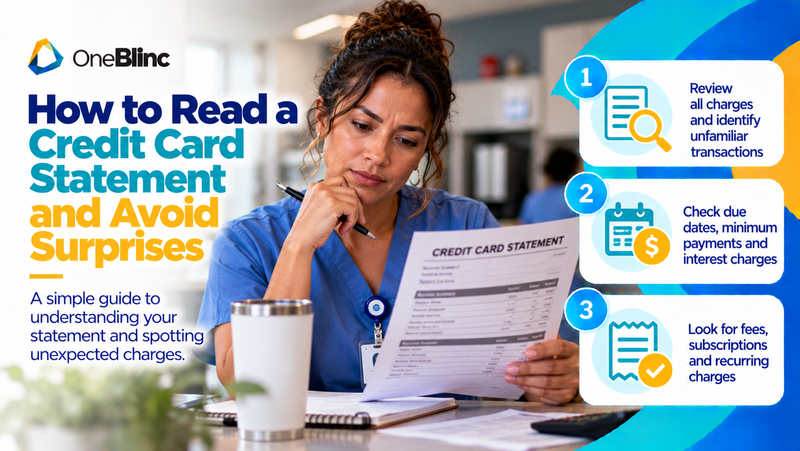
How to Read a Credit Card Statement and Avoid Surprises
A section-by-section guide to your credit card statement: due dates, minimum payment, interest, fees and utilization, so you avoid surprises...
Reviewed by Marco Moreno, Underwriter & Operations Manager · October 2026
A credit card statement contains more than the amount due. Understanding each section helps you identify charges and make informed repayment decisions.
Find the statement period and due date
The statement covers a specific billing cycle. The due date determines when at least the required payment must be received.
Distinguish statement balance and current balance
The statement balance reflects the closed billing period. The current balance can include newer purchases and payments.
Understand minimum payment
Paying only the minimum can result in interest and a longer payoff period. Review the issuer’s repayment illustration.
Review interest and fees
Look for annual fees, late fees, cash-advance charges, and interest calculations. Terms differ by account.
Dispute unfamiliar charges promptly
Check transactions and contact the issuer through official channels. Follow applicable dispute deadlines and procedures.
A section-by-section guide to your statement
Account summary
This box usually shows your previous balance, payments and credits, new purchases, cash advances, fees, interest charged, and your new balance. It is the quickest way to see what changed during the billing cycle.
Payment information
Here you will find the minimum payment, the payment due date, and the late payment warning, which explains the fee and potential penalty rate if you pay late.
Minimum payment warning
Most statements include a table showing how long it would take to pay off your balance making only minimum payments, and how much you would pay in total. It also often shows a higher monthly amount that would pay off the balance in about three years. Comparing those numbers can be eye-opening.
Transactions
A list of every purchase, payment, credit, and fee during the cycle. Review it for charges you do not recognize, duplicate transactions, or subscriptions you forgot about.
Interest charges
This section breaks down the annual percentage rate for each balance type, such as purchases, balance transfers, and cash advances, and how much interest was charged for each.
How credit card interest is calculated
Many card issuers calculate interest using your average daily balance. Each day's balance is added up over the billing cycle, divided by the number of days, and then multiplied by a daily rate based on your APR. Because of this, paying down your balance earlier in the cycle can reduce interest compared with paying at the last minute. The exact method is described in your cardholder agreement.
Understanding credit utilization
Your statement balance often becomes the number reported to credit bureaus. Credit utilization, the share of your available credit that you are using, is a significant factor in many credit scoring models. Keeping balances well below your limit can support your credit health. Some people make a payment before the statement closing date so a lower balance is reported.
Habits that prevent surprises
Set up autopay for at least the minimum payment to avoid late fees.
Turn on alerts for large purchases or when your balance approaches a set amount.
Review your statement monthly, even if you pay in full.
Read notices about changes in terms, which can include new fees or rate changes.
Example: minimum payment vs. a fixed amount
Suppose you carry a $2,000 balance at a 24% APR. If your minimum payment is around $60, much of each early payment goes toward interest, and paying off the card could take years. Increasing the payment to a fixed $150 a month would clear the balance far sooner and save a significant amount in interest. The exact figures depend on your card's terms, but your statement's minimum payment warning table shows the comparison for your own balance.
Related OneBlinc guides
Explore OneBlinc
If a paycheck timing gap is part of your situation, download OneBlinc to explore BlincAdvance™ and check current eligibility and terms. OneBlinc offers a subscription service starting at $8.99 per month, a free standard deposit option, and an optional instant deposit for an additional fee. Available advance amounts depend on eligibility and applicable terms. Only use an advance when you have a clear repayment plan.
Educational content only; not individualized financial, legal, tax, or medical advice. Eligibility rules apply.
Frequently Asked Questions
Does paying the statement balance avoid interest?
Often for eligible purchases when a grace period applies, but exceptions exist; review your card agreement.
Should I ignore the minimum payment if I plan to pay in full?
No. Make sure at least the required payment is received on time.
What is a credit card grace period?
It is the time between the end of a billing cycle and the payment due date. If you paid the previous balance in full, new purchases may not accrue interest during this period, but terms vary by card.
OneBlinc Editorial Team
The OneBlinc Editorial Team writes practical guides on budgeting, paychecks, saving, and handling financial emergencies. Every article is researched, edited for accuracy, and updated when rules or products change. Our content is educational and is not individualized financial advice.
OneBlinc Blog
OneBlinc helps eligible workers manage paycheck timing with BlincAdvance™. Eligibility and terms apply.
Visit SiteDon't miss an update!
Subscribe to get our fresh news!