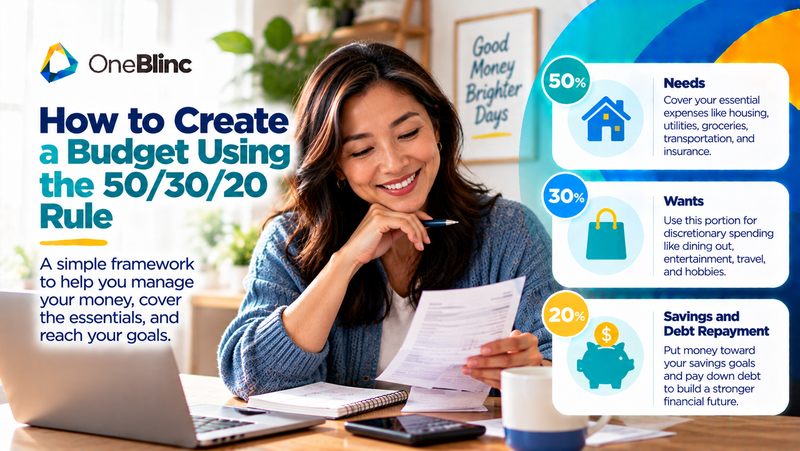
How to Create a Budget Using the 50/30/20 Rule
How to split take-home pay into needs, wants and savings with the 50/30/20 rule, plus how to adjust the split when essentials cost more...
Reviewed by Gil Hackl, Fintech Builder & Operator · October 2026
The 50/30/20 rule is a starting framework for dividing take-home pay into needs, wants, and savings or debt goals. It is a guide, not a requirement, and it may need adjustment for local living costs.
Understand the three categories
The traditional framework allocates 50% of after-tax income to needs, 30% to wants, and 20% to savings and certain debt-repayment goals. The distinction between categories matters more than perfect percentages.
Calculate using take-home pay
Use the money actually deposited after payroll deductions, not gross salary. For $2,500 in monthly net income, the guideline suggests $1,250 for needs, $750 for wants, and $500 for savings or debt goals.
Classify expenses carefully
Housing, basic groceries, utilities, and necessary transportation generally count as needs. Entertainment and optional upgrades generally count as wants. Required minimum debt payments are often treated as needs.
Adjust for your reality
In high-cost areas, essential expenses may exceed 50%. A modified split such as 65/20/15 may be more practical than forcing a target that does not match your household.
Use the framework to spot trade-offs
Review your actual spending and identify one category to improve. Track progress over several pay periods instead of judging one unusual month.
A practical example
For $3,000 in monthly take-home pay, the standard guide is $1,500 needs, $900 wants, and $600 savings or debt goals. These are planning targets, not limits imposed by a bank or app.
50/30/20 budget checklist
Start with your monthly take-home pay.
Calculate 50%, 30%, and 20% targets for needs, wants, and savings or debt.
Sort last month's spending into the three categories.
Adjust the split if your essential costs require a different balance.
Needs or wants? The gray areas
The hardest part of the 50/30/20 rule is deciding where some expenses belong. A basic phone plan may be a need for work, while the newest device upgrade is a want. Groceries are a need, but frequent takeout is usually a want. Your internet bill may be essential if you work from home. A useful test is to ask: if I lost this expense tomorrow, would it affect my health, safety, housing, or ability to earn income? If yes, it likely belongs in needs. If not, it probably belongs in wants, even if you value it highly.
Where debt payments fit
Minimum required payments on loans and credit cards are commonly treated as needs, because missing them has real consequences. Extra payments above the minimum usually go in the 20% category alongside savings. This approach keeps your obligations visible while rewarding progress on paying debt down faster.
Variations that might fit you better
The 50/30/20 split is a starting point, not a rule you must follow exactly. Some households use 60/20/20 when housing costs are high. Others use 70/20/10 when income is tight and essentials take most of the budget. Someone focused on paying off debt quickly might temporarily shrink wants to 15% and push 35% toward savings and debt. What matters most is that you choose a split intentionally and review it as your situation changes.
Make the rule automatic
Once you set your percentages, automation can make the plan easier to follow. Schedule a transfer to savings on payday so the 20% leaves checking before it can be spent. Some people use separate checking accounts for bills and for flexible spending, so it is clear how much is available for wants each pay period. Revisit the numbers every few months, especially after a raise, a move, or a change in household size.
Related OneBlinc guides
Explore OneBlinc
If a paycheck timing gap is part of your situation, download OneBlinc to explore BlincAdvance™ and check current eligibility and terms. OneBlinc offers a subscription service starting at $8.99 per month, a free standard deposit option, and an optional instant deposit for an additional fee. Available advance amounts depend on eligibility and applicable terms. Only use an advance when you have a clear repayment plan.
Educational content only; not individualized financial, legal, tax, or medical advice. Eligibility rules apply.
Frequently Asked Questions
Is the 50/30/20 rule realistic for everyone?
No. Housing costs, dependents, debt, and income can make different allocations more appropriate.
Where do emergency savings fit?
Emergency-fund contributions usually fit in the savings and financial-goals category.
Does the 50/30/20 rule use gross or take-home pay?
It is typically based on take-home pay, the amount left after taxes and payroll deductions.
OneBlinc Editorial Team
The OneBlinc Editorial Team writes practical guides on budgeting, paychecks, saving, and handling financial emergencies. Every article is researched, edited for accuracy, and updated when rules or products change. Our content is educational and is not individualized financial advice.
OneBlinc Blog
OneBlinc helps eligible workers manage paycheck timing with BlincAdvance™. Eligibility and terms apply.
Visit SiteDon't miss an update!
Subscribe to get our fresh news!