
Credit Checks vs. Credit Impact: What’s the Difference?
Soft vs. hard credit checks, what affects your credit score, and what to look for in a product's terms before you apply...
Reviewed by Marco Moreno, Underwriter & Operations Manager · October 2026
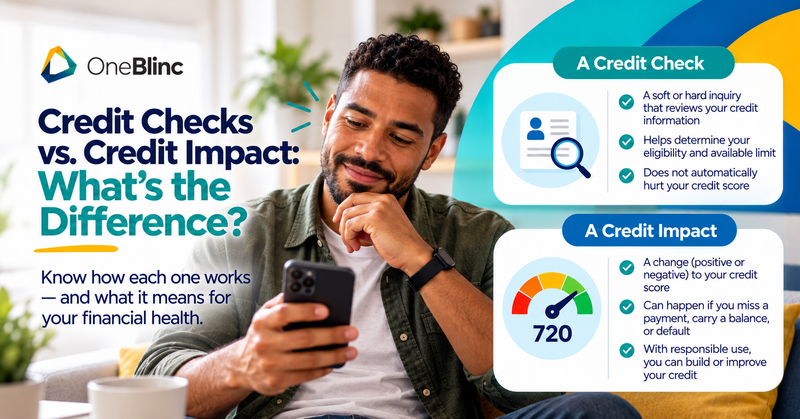
The phrases “credit check” and “credit impact” sound similar, but they describe different things. Knowing the difference can help you read financial-product disclosures more carefully.
What is a credit check?
A credit check is a review of credit information. Depending on the purpose and type of inquiry, it may be a hard inquiry or a soft inquiry. The distinction matters because not all inquiries affect credit scores in the same way.
What is a hard inquiry?
A hard inquiry is commonly associated with applications for certain types of credit. It may affect a credit score, although the impact varies by scoring model and individual credit history.
What is a soft inquiry?
A soft inquiry generally does not affect credit scores. Examples may include checking your own report or certain prequalification reviews, depending on the provider.
What does “no credit impact” mean?
This claim describes the effect on credit, not necessarily every step of eligibility verification. Do not interpret it as a blanket promise that no information is reviewed.
Questions to ask before signing up
Ask whether the service uses a hard or soft inquiry, whether activity is reported to credit bureaus, and what circumstances might change that treatment. Check current terms for the exact product.
A practical example
If an app says an eligibility process has no credit impact, read its explanation of how eligibility is determined. A claim about score impact is not the same as a claim that no verification occurs.
Credit check questions to ask
Ask whether the provider uses a hard or soft inquiry.
Ask whether account activity is reported to the credit bureaus.
Check your own credit reports for inquiries you do not recognize.
Keep copies of the disclosures that explain how credit is treated.
What actually affects your credit score
Inquiries are only one piece of your credit picture. Widely used scoring models generally consider several factors, though the exact weighting varies by model.
Payment history: whether you pay bills on time is typically one of the most important factors.
Amounts owed: how much of your available credit you are using, often called credit utilization.
Length of credit history: how long your accounts have been open.
New credit: recently opened accounts and hard inquiries.
Credit mix: the variety of credit types, such as cards and installment loans.
Because payment history and utilization usually carry more weight than inquiries, paying on time and keeping balances manageable tend to matter more over the long run than avoiding every credit check.
Rate shopping and multiple inquiries
If you are shopping for certain types of loans, such as a mortgage or auto loan, some scoring models treat multiple inquiries within a short window as a single inquiry. This allows you to compare offers without being penalized repeatedly. The length of that window can differ by model, so it is wise to complete your rate shopping within a few weeks. This treatment typically does not apply to applications for multiple credit cards.
How to check your credit for free
You are entitled to free copies of your credit reports from the three major credit bureaus through AnnualCreditReport.com, the official site authorized by federal law. Checking your own report is a soft inquiry and does not affect your score. Review each report for accounts you do not recognize, incorrect balances, or late payments you believe are wrong.
Disputing an error
If you find a mistake, you can file a dispute directly with the credit bureau reporting it. Include copies of documents that support your case, and keep records of everything you send. Bureaus generally must investigate and respond within a set timeframe.
Related OneBlinc guides
Explore OneBlinc
If a paycheck timing gap is part of your situation, download OneBlinc to explore BlincAdvance™ and check current eligibility and terms. OneBlinc offers a subscription service starting at $8.99 per month, a free standard deposit option, and an optional instant deposit for an additional fee. Available advance amounts depend on eligibility and applicable terms. Only use an advance when you have a clear repayment plan.
Educational content only; not individualized financial, legal, tax, or medical advice. Eligibility rules apply.
Frequently Asked Questions
Does checking my own credit hurt my score?
Checking your own credit report is generally a soft inquiry and does not lower your credit score.
Can different lenders use different credit scores?
Yes. Lenders may use different scoring models and credit reports, so results can differ.
How long does a hard inquiry stay on my credit report?
Hard inquiries generally remain on credit reports for about two years, though their effect on scores usually fades sooner.
OneBlinc Editorial Team
The OneBlinc Editorial Team writes practical guides on budgeting, paychecks, saving, and handling financial emergencies. Every article is researched, edited for accuracy, and updated when rules or products change. Our content is educational and is not individualized financial advice.
OneBlinc Blog
OneBlinc helps eligible workers manage paycheck timing with BlincAdvance™. Eligibility and terms apply.
Visit SiteDon't miss an update!
Subscribe to get our fresh news!